
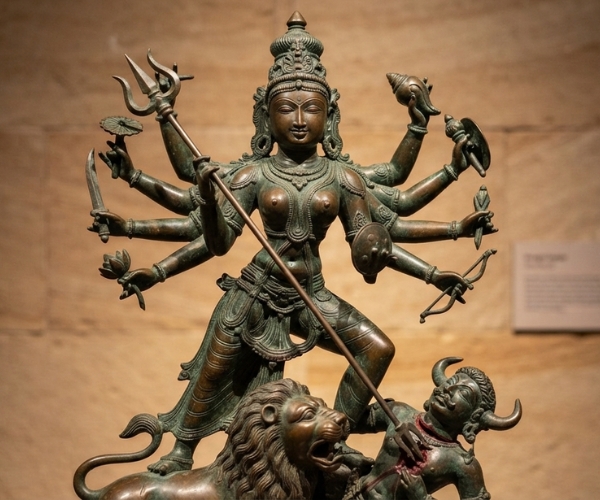
The creation of a Durga idol is a masterclass in balancing power and grace. In classical Indian sculpture, Durga is not merely a warrior; she is the embodiment of Shakti, the primordial cosmic energy. To capture this energy in stone or metal, artisans follow the rigorous proportions of the Shilpa Shastras, ensuring that her form conveys both her supreme authority and her maternal protection.
The Geometry of Power: The Dashabhuja Form
The most iconic representation of Durga is the Dashabhuja, or the ten-armed goddess. From a structural standpoint, managing ten arms in a single sculpture requires a sophisticated understanding of balance and radial symmetry. Each arm is positioned to create a halo of weapons, yet they must appear to emerge naturally from her torso without cluttering the visual field. This multi-armed iconography suggests that the Divine is omnipresent and capable of multitasking on a cosmic scale, protecting, creating, and destroying simultaneously. In the Tala Mana system of measurement, Durga is often sculpted in the Uttama Dashatala, the highest ten-part proportion, giving her a towering, heroic stature that commands the space she occupies.
The Science of the Three Bends
While Durga is a warrior in the midst of battle, classical sculpture rarely depicts her as strained or aggressive. Instead, she is often shown in the Tribhanga posture, which consists of a three-fold bend at the neck, waist, and knee. This pose is one of the most difficult to achieve in sculpture, as it requires a perfect distribution of weight to prevent the stone from cracking. The Tribhanga pose imbues the goddess with a sense of fluid, rhythmic movement. It suggests that even in the heat of her conflict with the demon Mahishasura, she remains centred, graceful, and serene. Her face, following the rules of Dhyana Shloka, typically maintains a Soumya, or gentle, expression, creating a striking contrast with the weapons she wields.
Weapons as a Universal Code
Every weapon held by Durga is a symbolic word in a larger visual sentence. These are not merely instruments of war but representations of the various powers bestowed upon her by the gods. The Trident, or Trishula, gifted by Shiva, features three prongs representing the three Gunas, Sattva, Rajas, and Tamas, and her mastery over them. The Sudarshana Chakra, gifted by Vishnu, is a spinning discus that symbolises the wheel of time and the righteousness governing the universe. The Conch, or Shankha, symbolises the primordial sound of creation, Om, reminding the devotee that the source of all power is vibration. Often a lotus is held in a lower hand, signifying that even in the midst of a worldly battle, one must remain detached and pure.
The Conquest of the Ego
At the base of the classical Durga idol lies the final architectural element, consisting of the lion and the buffalo demon, Mahishasura. The lion, her Vahana, represents raw power, courage, and animal instinct, which the goddess has harnessed and channelled. The struggle with Mahishasura is the ultimate representation of the victory of Dharma over Adharma. In sculpture, the demon is often shown emerging from the severed neck of a buffalo, symbolising the moment the soul is liberated from the animal state of ignorance and ego. Durga’s spear, aimed at the demon’s chest, is the point of finality, a visual representation of divine knowledge piercing through the heart of darkness.
Understanding Durga’s iconography is about recognising the harmony between the fierce and the feminine. Through precise proportions and deliberate symbolism, classical Indian sculpture transforms a battle scene into a meditative map of the human psyche. It reminds us that true strength is not found in anger, but in the calm, balanced, and purposeful application of our inner power.