
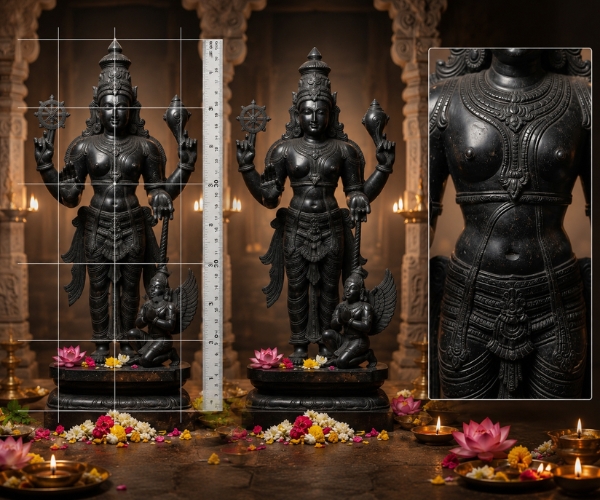
It’s not just a matter of artistic instinct or creative whim to make an idol of a Hindu god. The Shilpa Shastras, ancient texts that see the sculptor as both an engineer and a religious figure, say that it is a precise science. In this tradition, beauty is not a matter of opinion; it is a mathematical representation of cosmic order.
To understand a Hindu idol, one must comprehend the “Tala Mana” system, which is the basic grammar of divine proportion.
The Tala Mana: The Divine Metric
The Tala, a unit of measurement that is about the same length as a person’s face (from the hairline to the chin), is at the heart of Hindu iconography. This system makes sure that each god has a height that matches their unique metaphysical traits.
For example, the Dashatala (ten-part) proportion is often used to show a major god like Vishnu or Shiva, which makes them look big and heroic. On the other hand, Ganesha or child forms of Krishna may adhere to the Panchatala (five-part) or Chatushtala (four-part) systems, leading to the characteristic “squat” and grounded appearance that signifies stability and accessible divinity. These ratios are not just for looks; they are meant to make the devotee feel a certain way, which is called Bhava.
The Geometry of Posture: Bhangas
Bhanga, or the science of body bends, makes proportion even better. A perfectly straight, vertical posture (Samabhanga) shows spiritual balance and ultimate control. You can often see this in statues of Surya or Vishnu.
The idol looks more fluid and graceful as the “bends” get bigger, like the Tribhanga (three-fold bend) that you often see in Krishna or dancing goddesses. These three bends at the neck, waist, and knee make a rhythmic flow that is like the energy of life. The sculptor uses these proportions to show that the divine is both eternal and still, but it is also what makes everything move in the universe.
Symbolism Through Sacred Anatomy
After the proportions are set, the iconography adds layers of “code” that are philosophical. Every part of the body is a vessel for meaning. To show the Ayudhas (weapons or tools) and Mudras (gestures) that show the deity’s power, the structure needs to have more than one arm.
The Abhaya Mudra (palm facing outward) is a universal sign of protection, and the Varada Mudra (palm facing downward) means that you are giving someone a gift. The “Vahana,” or animal vehicle at the base of the idol, is not just a companion; it also stands for the lower instincts or cosmic forces that the god has mastered. The idol shows that higher consciousness is stronger than raw nature by standing on or riding these animals.
The Breath of the Stone
Prana is the most subtle stage of classical iconography. A master sculptor makes sure that even a stone statue looks like it’s “breathing”. This is accomplished via the subtle distension of the thorax and the gentle shaping of the abdomen, indicating that the form is imbued with Prana-Vayu (the life breath).
When the proportions are right, the posture is right, and the symbols are in the right places, the idol is no longer a block of granite or bronze. It turns into a “Yantra”, a picture that helps the mind focus on the infinite.
The base of Hindu god idols is a mix of strict maths and flexible devotion. The craftsman makes sure that the human eye is drawn to the divine by following the rules of proportion. It serves as a reminder that in Hinduism, the sacred is found within the structure, and the most profound truths are often concealed in the most accurate measurements.