To someone who doesn’t know much about art, a Ganesh statue looks like a beautiful picture of a god with an elephant head. The craftsman who knows the Shilpa Shastra, on the other hand, has to do a lot of hard work to build the idol. Every trunk curve and finger digit follows a specific ratio called Tala Mana. This is an old design code that makes sure the physical body stays an ideal channel for cosmic energy.
The Science of Sacred Proportion
“Tala” is the basic unit of measurement in traditional Indian art. It is the distance between the hairline and the chin. Ganesha is not like human figures, which usually have eight or nine parts. People often show him using the Sapta-Tala (seven-part) or Pancha-Tala (five-part) systems. This intentional “squatness” makes it look very heavy and solid.
His big, hefty head represents the breadth of the mind and the value of thinking broadly. In contrast, a round, voluptuous abdomen represents the capacity to “digest” all of life’s experiences, both the bitter and the sweet, with composure. A classical idol is usually constructed with a concealed centre of gravity despite its massive proportions, symbolising a spirit that stays perfectly anchored even as it strives for more knowledge.
A Visual Map of Philosophy
When we look closely at the idol’s features, we see a complicated language of symbols that is right in front of us. The big ears are not just a physical trait; they are a reminder to listen more and talk less. They are like a “receiver” for divine wisdom. His small eyes, which are often shown with a piercing gaze, stand for the power of “Ekagrata”, or one-pointed focus.
The single, broken tusk is one of the most interesting parts of the classical structure. This feature, called Ekadanta, shows that one must go beyond the ideas of good and evil or pleasure and pain to find true peace. It also tells a story of sacrifice. For example, Ganesha broke his own tusk to use as a stylus when the pen broke while the Mahabharata was being copied. The way the trunk is bent is also a choice: a curve to the left matches the cool, moon-like energy of household prosperity, while a curve to the right brings to mind the fiery, sun-like energy of spiritual freedom.
The Four Arms and the Inner Self
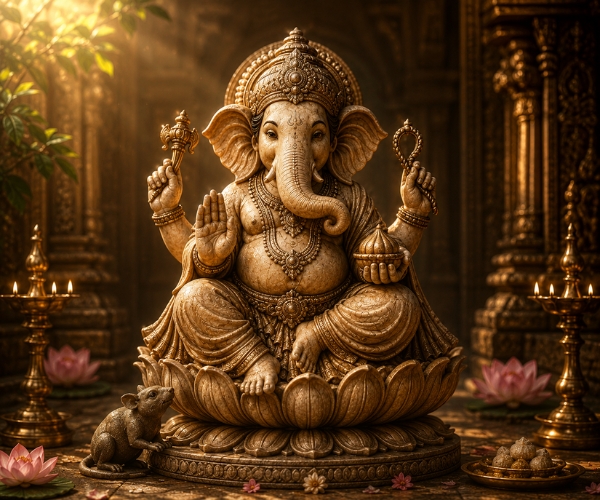
The idol’s classical four-armed pose is probably the most interesting part of its design. These arms stand for the Antahkarana, which are the four tools that the human soul uses. He has the Pasha (noose) in one hand to catch wandering desires and the Ankusha (goad) in the other to push himself in the right direction.
The other hands often switch between the Abhaya Mudra, which means “protection and fearlessness”, and holding a Modak, which stands for the ultimate reward of spiritual practice. The tiny mouse at the base of the huge idol also serves a structural and symbolic purpose. It stands for the “ego” or restless desire; by placing it at his feet, the sculptor shows that a truly wise person controls their instincts instead of being led by them.
The beauty of a classical Ganesh idol is in the way that the big and the small are in tension with each other. The proportions, from the heavy elephant head to the soft lotus seat, remind us that the divine is both very powerful and very easy to reach. When you stand in front of an idol again, don’t just look at the clay and paint; look at the perfectly balanced map of the human mind.