
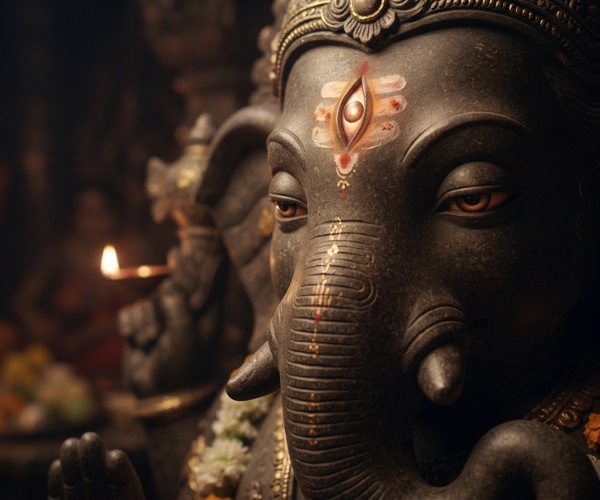
The idea of Drishti, or gaze, is probably the most spiritually charged part of Ganesh iconography. In the world of sacred art, an idol is not “complete” until the eyes are painted. This is called Netra Unmeelanam, or “opening of the eyes.” This is the moment when the sculpture goes from being a work of art to a living thing. By understanding the Drishti of a Ganesh idol, we can see how the deity’s “vision” shows us how we are spiritually right now.
The Inner and Outer Gaze
In classical iconography, Ganesha’s eyes are almost always shown as small and like those of an elephant. This is a deliberate choice. These “small eyes” stand for Ekagrata, which means “one-pointed focus”. The human mind tends to drift towards things that are going on outside, but Ganesha’s gaze is steady and fixed.
His Drishti has a deep duality: his eyes are often half-closed, which means he is in a state of Antar-Drishti, or inner vision. This implies that although he is cognisant of the external world, his principal emphasis is on the expansive, internal terrain of the soul. For the seeker, this is a visual reminder that true wisdom comes from looking inside yourself instead of being distracted by the noise of the outside world.
The Direction of the Trunk and Visual Flow
The direction of a Ganesh idol’s trunk often adds to its Drishti, which is the “energy” of the gaze. When the trunk turns to the left (Vamamukhi), his gaze is said to be “Chandra-Drishti”, which means “moon-like”. This is a soft, cool, and caring look that has to do with the householder’s life, wealth, and happiness. It is a look of compassion that tries to get rid of problems with grace.
On the other hand, an idol with a trunk that turns to the right (Dakshinmurti) has “Surya-Drishti”, which is energy like the sun. This look is strong and intense, showing the fire of spiritual discipline and freedom. People say that this form of Ganesha “looks” right into the ego and burns away impurities. These idols are usually kept in temples or other places of strict daily worship because the energy of this Drishti’s gaze is thought to be too strong for a casual setting.
The Gaze of Protection and Wisdom
The way the eyes are placed on the huge elephant head also gives a sense of Vibhuti, or divine all-pervasiveness. His head is so big that it looks like he is looking in all directions at once. Because of this, Ganesha is the “Lord of Beginnings.” His Drishti clears the way for us before we even step on it.
Ganesha is also shown with a third eye on his forehead in many traditional sculptures, but it is usually not very noticeable. This eye is the “Jnana-Drishti,” or the eye of knowledge. It is the vision that sees through the illusion of Maya. When a devotee stands in front of a Ganesh idol, the “Drishti” is meant to be a two-way street. The devotee sees the deity, but more importantly, they feel seen by the deity. This is a moment of deep recognition that starts to break down the ego.
Drishti is not just how an idol looks; it’s also how it “sees” the world and the devotee. The Drishti of Ganesha is like a mirror, showing the gentle, cooling gaze of a left-turned trunk or the sharp, focused intensity of the inner eye. It pushes us to focus on one thing, shut out outside noise, and eventually look inside ourselves to find the same peace that the god represents.