
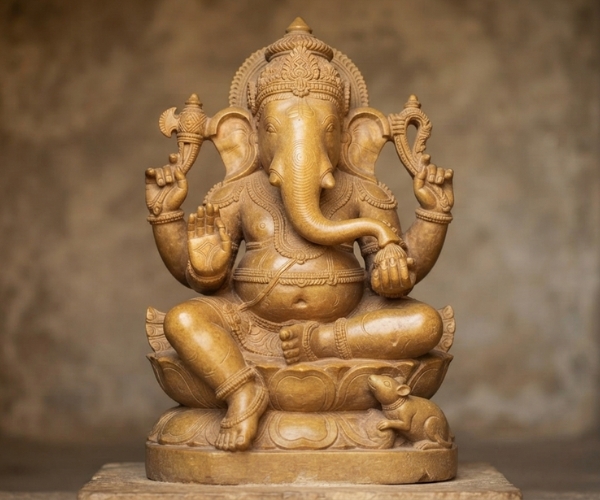
In the world of classical Indian sculpture, the creation of a Ganesh idol is far more than an artistic endeavour; it is a disciplined practice governed by the Shilpa Shastras. These iconographic canons serve as the architectural blueprint for the divine, ensuring that every physical attribute is a precise mathematical reflection of a spiritual truth. By adhering to these ancient rules, the sculptor transforms raw material into a “Vigraha”, a form that can capture and radiate cosmic energy.
The Mathematical Soul: Tala Mana
The foundation of any classical idol lies in the Tala Mana system of measurement. A “Tala” is a standardised unit of proportion, traditionally based on the distance from the hairline to the chin. For a Ganesh idol, the canons typically dictate the use of the Pancha-Tala (five-part) or Sapta-Tala (seven-part) scale.
This specific choice of ratio is what gives Ganesha his iconic, grounded appearance. Unlike the elongated, heroic proportions used for deities like Shiva or Vishnu, Ganesha’s shorter vertical scale emphasises stability and “Grahapati”, the Lord of the household and the earth. Every limb is calculated in relation to this central unit, ensuring that the massive elephant head remains in perfect physical and aesthetic equilibrium with the rounded belly and seated limbs.
The Language of Posture and Bhanga
The canons also define the “Bhanga”, or the posture and “bend” of the body, which dictates the idol’s emotional resonance. A Ganesh idol designed for a temple or a home altar often follows the Samabhanga (equally balanced) or a gentle Abhanga (slight off-centre bend). These postures are mathematically calculated to suggest a state of “Shantam”, absolute peace and stillness.
When the idol is sculpted with the correct centre of gravity according to the Shastras, it conveys a sense of immovable wisdom. Even in more dynamic forms, such as the dancing Nritya Ganesha, the canons provide strict rules for the radial symmetry of the arms and the tilt of the head. This ensures that the movement feels divine and rhythmic rather than chaotic, maintaining the “Sattva” or purity of the form even in motion.
The Symbolic Codes of the Antahkarana
Beyond the primary measurements, the iconographic canons act as a mandatory checklist for symbolic features, known as Laksanas. These are the specific marks that identify the deity’s internal faculties. The four arms of a classical Ganesh idol are not merely a supernatural trait; they represent the four components of the inner self: the mind, the intellect, the ego, and the conscience.
The Shastras mandate exactly what each hand must hold to communicate this philosophy. The Pasha (noose) and Ankusha (goad) are placed with geometric precision to show the balance between restraining worldly desires and prodding the soul toward spiritual growth. The broken tusk, the direction of the trunk, and even the placement of the “Mushika” (mouse) at the base are all governed by these canons. Without these specific iconographic markers, the sculpture would lose its “Dhyana”, the meditative quality that allows a devotee to focus their mind on the infinite.
The iconographic canons of the Shilpa Shastras are the bridge between the physical and the metaphysical. By following these rigorous laws of proportion and symbolism, the sculptor ensures that the Ganesh idol is not just a representation but a functional spiritual tool. It is this marriage of rigid mathematics and deep-rooted heritage that has allowed the classical form of Ganesha to remain consistent and powerful through the centuries, serving as a timeless anchor for the human spirit.