
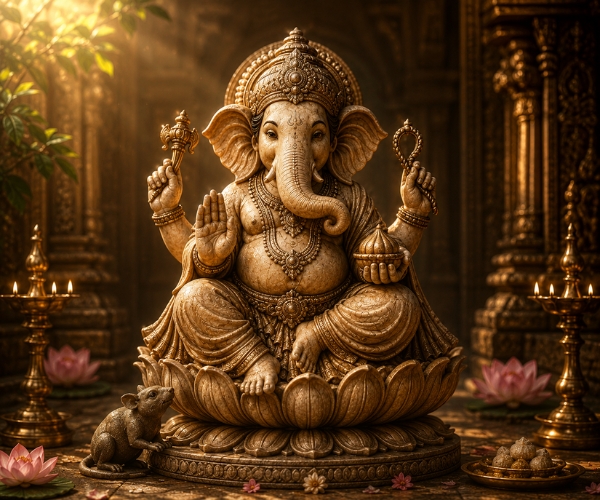
The Divine Geometry: Understanding the Proportion and Symbolism of Ganesha
To someone who doesn’t know much about art, a Ganesh statue looks like a beautiful picture of a god with an elephant head. The craftsman who knows the Shilpa Shastra, on the other hand, has to do a lot of hard work to build the idol. Every trunk curve and finger digit follows a specific […]

Meaning of Drishti in Ganesh Iconography
The idea of Drishti, or gaze, is probably the most spiritually charged part of Ganesh iconography. In the world of sacred art, an idol is not “complete” until the eyes are painted. This is called Netra Unmeelanam, or “opening of the eyes.” This is the moment when the sculpture goes from being a work of […]
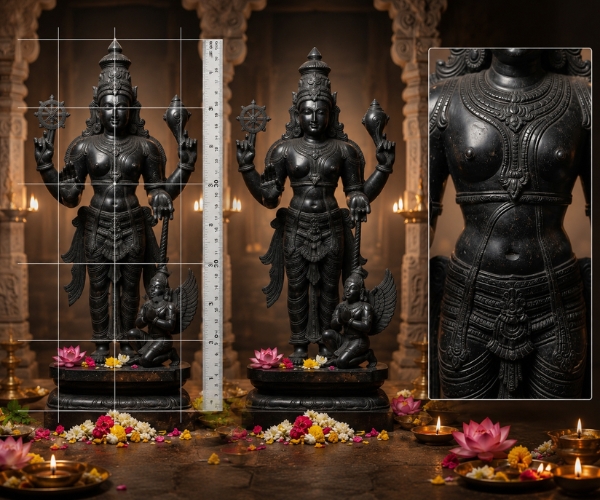
Iconography and Proportion: The Foundation of Hindu God Idols.
It’s not just a matter of artistic instinct or creative whim to make an idol of a Hindu god. The Shilpa Shastras, ancient texts that see the sculptor as both an engineer and a religious figure, say that it is a precise science. In this tradition, beauty is not a matter of opinion; it is […]
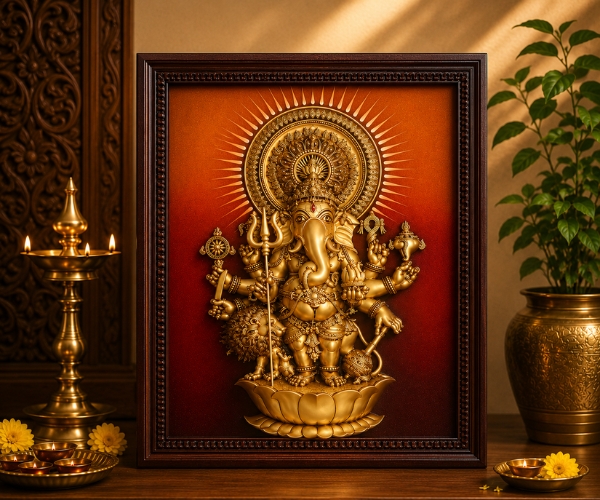
Ganesh Idol for Home: Cultural Significance Beyond Placement
For many, bringing a Ganesh idol into a home is a deeply personal milestone, often associated with new beginnings and the seeking of protection. While modern advice frequently focuses on the technicalities of Vastu or the physical placement of the deity within a room, the cultural significance of the idol runs much deeper. In the […]
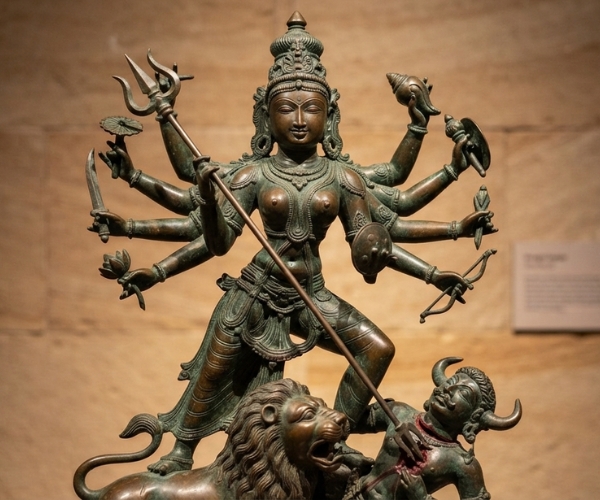
Understanding Durga’s Iconography in Classical Sculpture
The creation of a Durga idol is a masterclass in balancing power and grace. In classical Indian sculpture, Durga is not merely a warrior; she is the embodiment of Shakti, the primordial cosmic energy. To capture this energy in stone or metal, artisans follow the rigorous proportions of the Shilpa Shastras, ensuring that her form […]
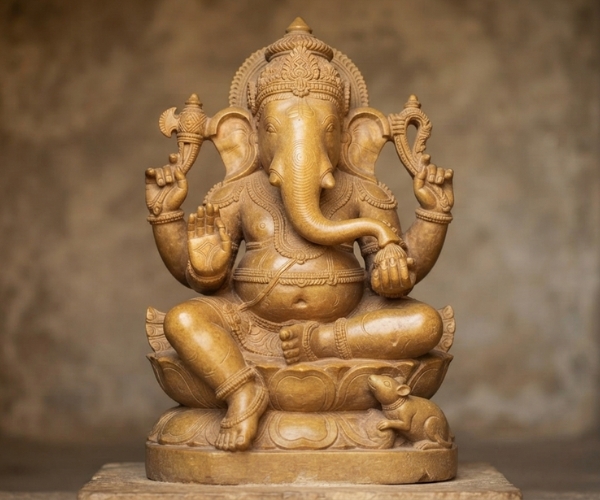
How Iconographic Canons Shape the Ganesh Idol
In the world of classical Indian sculpture, the creation of a Ganesh idol is far more than an artistic endeavour; it is a disciplined practice governed by the Shilpa Shastras. These iconographic canons serve as the architectural blueprint for the divine, ensuring that every physical attribute is a precise mathematical reflection of a spiritual truth. […]