
About Baskaradoss
Art, for Baskaradoss, has never been a profession alone. It has been a lifelong discipline shaped by reverence for form, heritage, and cultural continuity.
Born in the temple town of Chidambaram, his early interest in drawing demonstrated both instinct and dedication. His formal training at the Government School of Arts and Crafts in Kumbakonam provided a solid foundation in classical technique, proportion, and composition. Recognised early for academic excellence in freehand drawing and engineering perspective, he established a practice based on both precision and expression.
Over the years, his work diversified into painting, architectural drawing, exhibition design, and sacred restoration. Among his most significant early contributions was the restoration of centuries-old temple frescoes at the Madurai Meenakshi Amman Temple Art Gallery, which deepened his understanding of traditional Indian aesthetics and spiritual art. Further training in fresco techniques and architectural studies honed his understanding of structure, symbolism, and long-lasting design.
His career encompassed national and cultural platforms. As an art educator, he was recognised by the central government for his contribution to drawing education. As an art director and exhibition designer, he oversaw the development of major national pavilions and cultural exhibitions throughout India. His projects have been inaugurated and recognised by national leaders and cultural dignitaries, demonstrating the trust placed in his artistic vision.
Beyond exhibitions and restoration, his studio practice remained active. He created an extensive oil series narrating the Ramayana, portraits of freedom fighters, and tributes to national heroes, which are still on display in public and institutional spaces. These projects demonstrate not only artistic skill but also a deep understanding of India’s historical and spiritual narratives.
However, the turning point in his journey occurred in 1999.
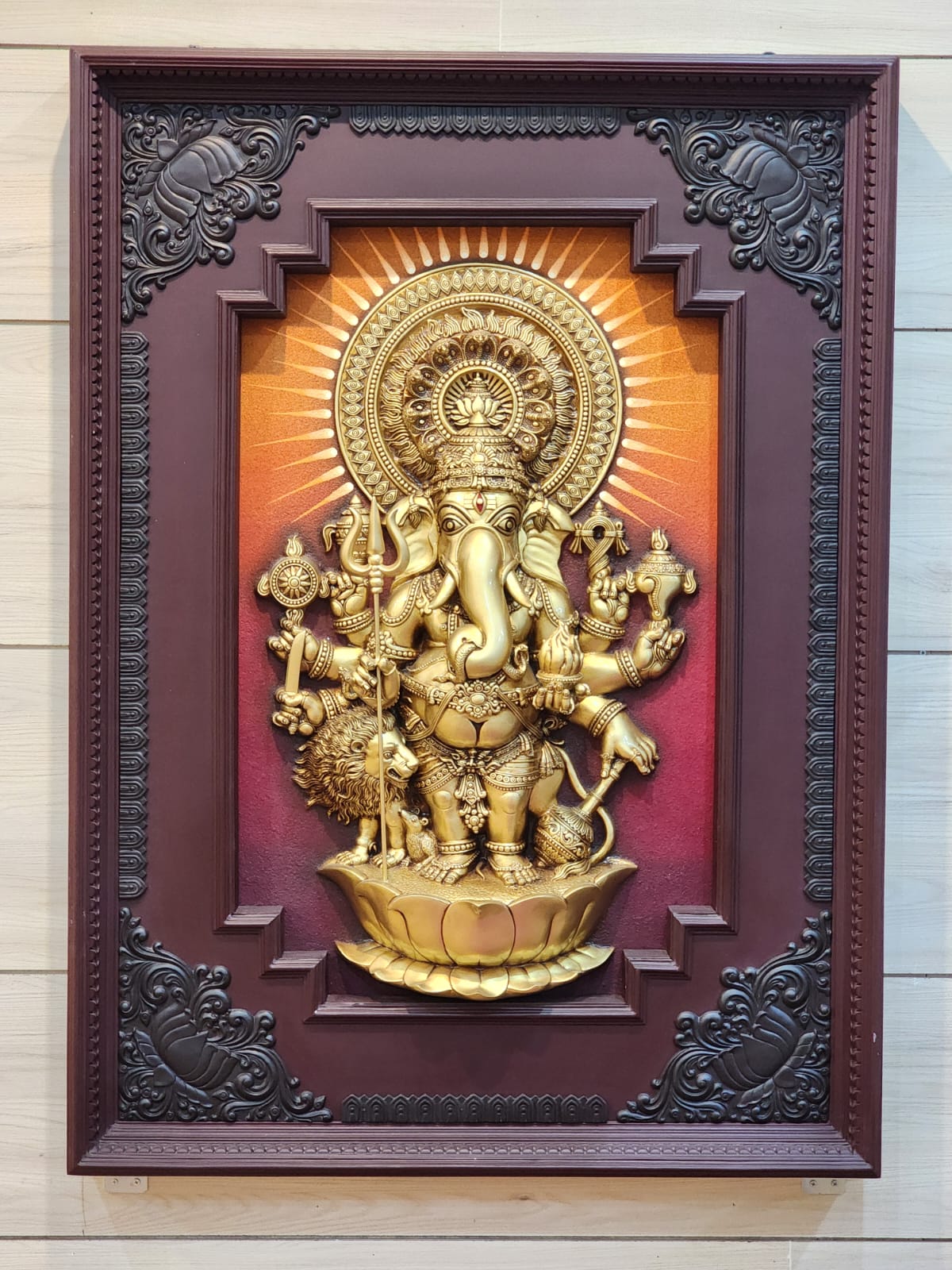
Inspired by Sri Shuba Drishti Ganapathy’s profound vision, he felt compelled to give it sculptural form. Shilpashree emerged from this moment, not as a commercial venture, but as an extension of artistic and spiritual responsibility.
T. Baskaradoss used Shilpashree to preserve classical Indian iconography with discipline and integrity. His sculpture approach is guided by established iconographic principles, careful proportional analysis, and a respect for inherited traditions. Each form is designed not only for ornamentation but also for continuity, ensuring that sacred representation remains culturally relevant even in contemporary settings.
Today, after over six decades of artistic involvement, his dedication remains unwavering. His work continues quietly, shaped by patience rather than haste, and guided by the conviction that heritage should be preserved through practice rather than nostalgia.
His Vision
Shilpashree’s vision is simple yet enduring: to preserve classical Indian iconography with dignity, scholarship, and artistic discipline.
In an era when mass production frequently trumps traditional form, the goal is not replication but preservation. Each sculpture is approached with a focus on symbolic accuracy, structural balance, and cultural continuity. The goal is not volume but integrity.
T. Baskaradoss sees sculpture as a means of connecting generations. T. Baskaradoss sees sculpture as a means of connecting generations. It moves history, belief, proportion, and meaning forward. It moves history, belief, proportion, and meaning forward. Shilpashree embodies the principles that shaped his own artistic foundation: discipline in execution, respect for tradition, and responsibility for cultural heritage. Shilpashree embodies the principles that shaped his own artistic foundation: discipline in execution, respect for tradition, and responsibility for cultural heritage.
His journey is more than just a personal story; it also demonstrates the enduring strength of India’s classical artistic traditions.
About Shilpashree
A Legacy of Classical Form
Shilpashree was founded as a continuation of T. Baskaradoss’s lifelong interest in India’s classical artistic traditions. After decades of painting, restoration, exhibition design, and sacred iconography, the focus shifted to sculpture, not as expansion, but as refinement.
In 1999, inspired by Sri Shuba Drishti Ganapathy’s profound vision, Baskaradoss embarked on a disciplined exploration of sacred form based on scriptural study and established iconographic principles. What began as reflection eventually evolved into a structured sculptural practice. Shilpashree emerged as a dedicated platform for preserving classical representation in a clear and responsible manner.
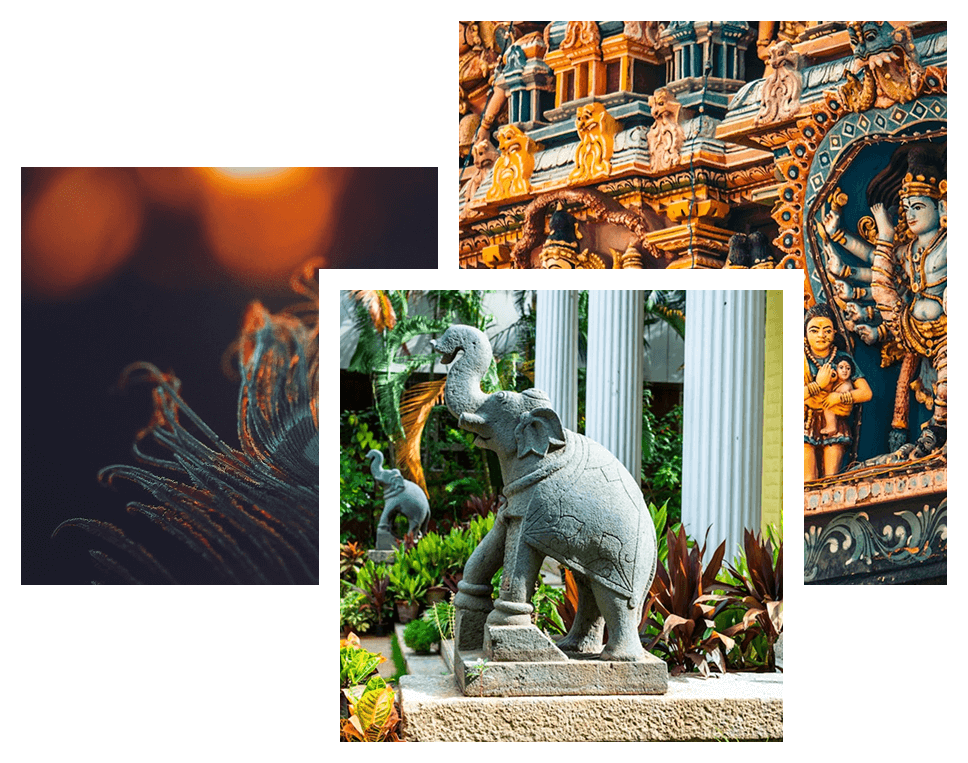
The foundation of Shilpashree is based on proportion, symbolic accuracy, and compositional balance. Each form is approached with study rather than impulsiveness, ensuring adherence to traditional canons that have shaped Hindu iconography for centuries. The emphasis is not on novelty, but on preserving forms that bring cultural depth into contemporary spaces.
Shilpashree’s work has been featured in homes, institutions, and cultural settings throughout India and around the world. The brand works selectively with partners who value heritage, craftsmanship, and disciplined execution. Growth has been measured, driven by artistic integrity rather than scale.
Shilpashree is fundamentally committed to preserving classical Indian sculpture in a thoughtful, restrained, and long-lasting manner. It represents a careful continuation of tradition rather than a departure from it.
About Sri Shuba Drishti Ganapathy
The word ‘drishti’ means sight, or what one sees. A natural or casual look at anything is harmless. But it is undeniable that the shafts of sight tinged with the element of jealousy have the power of destroying the thing or the person which they strike. This kind of evil look is what is called in Tamil ‘KAN DRISHTI’ (evil eye).
To take a common example, the sunrays falling on earth are harmless. But when a ray of sunlight is focused through a lens on an object, it reduces the object to ashes. In the same way, a casual look at something does no harm. If the look bearing the evil qualities like envy, jealousy or any other wicked thoughts falls on an object or a person, it has a destructive effect. This is known as the evil look, ‘KAN DRISHTI’.
It is a common observation that the mother fondly applies a black dot on the cheek of her baby with a view to ward off the influence of an evil eye. She also adopts some traditional rituals, like throwing away a lemon after waving it before the baby a number of times, in order to protect him/her from such baneful influence.
Every Friday and new moon day, shopkeepers burn camphor and break coconuts in front of their shops. Breaking the white guard in front of the shops is also common practice. Yet others put up a full-size white guard with black and red dots on it or with some kind of body drawn on it so as to act as a charm against the evil eye. Even today these practices are in vogue.
Use of a talisman or amulet also has a desirable effect. Some others perform Homas or seek the assistance of an incantator or Mantrika.
Thus, in short, people resorting to several such practices to protect themselves, their children or any of their belongings from the influence of the evil eye has been an ancient custom. This practice cannot be brushed aside as silly superstition. None of the practices of our ancients were without a meaning or significance. Experience alone can convince us of this truth.
Therefore, that this evil power of an evil look is something which has to be accepted scientifically is being explained today with proper proofs. The convergence of some wicked forces transforming itself into a magnetic wave capable of striking the victim at any unguarded moment is an evil look.
In this scientific age, more and more new medicines are being invented to cure many a dreaded disease. But no scientist has ever invented a cure to combat the evil attacks of the evil look, nor has anyone attempted to think on these lines. But now there is an urgent need for it: the need to destroy root and branch this great evil power of evil looks and thereby protect the earth from its onslaughts.
Sage Agastya, the greatest among the Siddhas (spiritually enlightened ones) of our land, caused a great power to be born. It is the all-powerful Lord.